
If you’ve googled “Is Honduras safe?” and found yourself staring at State Department warnings and crime statistics, I completely understand the hesitation. I got some very confused looks the first few times I told people I was going to Honduras. It does does carry a complicated reputation — but here’s the thing: Roatan is not the Honduras you’ve been reading about. Separated from the mainland by 40 miles of open sea, this small island operates in an almost entirely different world. I’ll give you my personal opinion and anecdotal experience, and they we’ll dig into some of the particulars.
TLDR: YES, ROATAN IS SAFE
I’ve been to Roatan as a tourist over 25 times and have never felt unsafe. Does that mean there’s no crime? Of course not. But I use common sense and situational awareness the same way I do when I travel anywhere, and I’ve never had an incident or felt unsafe in any way. Don’t get blackout drunk. If you do, do in with a group of friends and stick with them. Don’t draw attention to yourself. Don’t wear your $5,000 watch. Stick to the tourist areas at night. Don’t follow that hilarious new friend you made at the bar to an “after-hours” in Coxen Hole. Don’t avail yourself of the local drug dealer. (Sidenote: You’ll encounter people smoking weed, and its not that hard to find if you want it, but just remember that the consequences of being arrested with it are *exponentially* higher in Honduras than they are at home. So factor that into your risk/reward calculations.)
Roatan vs. Mainland Honduras
The concerns that dominate headlines about Honduras — gang activity, violent crime, instability in cities like Tegucigalpa and San Pedro Sula — are rooted in the realities of the mainland. Roatan sits 40 miles offshore and has a completely different character, economy, and daily reality than anywhere on the Honduran mainland.
Would you avoid visiting the Greek island of Santorini because of crime statistics from Athens? The geographic and cultural distance between Roatan and the Honduran mainland is similar. Roatan’s economy is driven almost entirely by tourism and expat residents — which means the island has every incentive to keep visitors safe, welcome, and happy. The local government, businesses, and community all depend on it.
The U.S. State Department’s own travel advisory acknowledges this distinction, noting that resort areas in the Bay Islands, including Roatan, have a higher concentration of law enforcement resources and are better policed than most of the mainland.
The Reality of Day-to-Day Life in West End
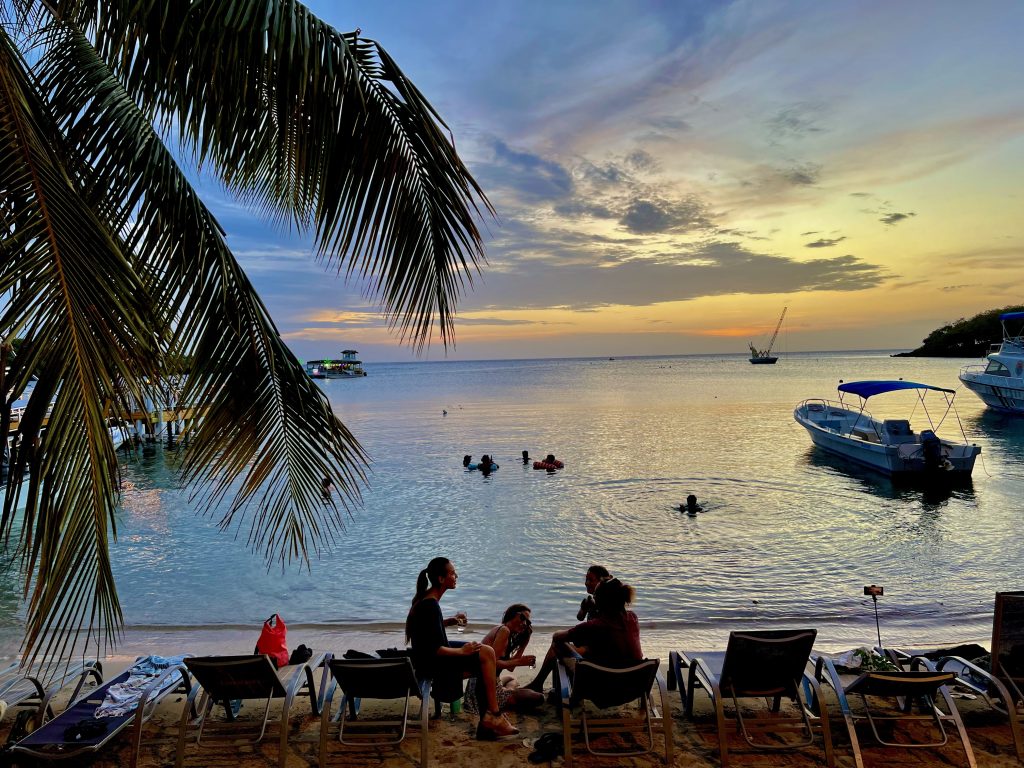
West End is Roatan’s most popular visitor hub — a mile-long stretch of sandy beach, dive shops, open-air restaurants, and bars. The vibe is relaxed and social, and it’s the kind of place where solo travelers, couples, families, and retirees all feel equally at home.
The community is a tight-knit mix of locals, long-term expats from the US, Canada, and Europe, and a constant flow of divers and beach lovers. Everyone knows everyone. Restaurant owners remember your name by your second visit. It “feels” safe.
That said, common-sense travel precautions always apply, on Roatan as anywhere in the world:
- Don’t flash expensive jewelry, cameras, or electronics unnecessarily.
- Use your accommodation’s safe for passports and valuables.
- Avoid walking in unfamiliar, unlit areas late at night.
- Bring only the cash you need for the day.
- Be cautious at ATMs — some have been compromised, so use machines inside banks or well-trafficked businesses when possible. This has been less of an issue in recent years, but it’s still not a terrible idea to change your PIN once you get back home.
These are the same tips you’d follow in any tourist destination. They’re not Roatan-specific warnings — they’re just smart travel habits.
Is West End Safe at Night?
Yes — West End has a thriving nightlife scene, and people walk the main strip after dark regularly without issue. The restaurants, beach bars, and music venues keep things animated well into the evening, and there’s safety in numbers in a busy tourist area. Staying on the main strip and well-lit areas is simply good practice, but the neighborhood itself is well-traveled and well-lit.
What About Health & Water Safety?
We talk about this more in-depth in a separate post but worth mentioning here as well. One practical safety note that often goes overlooked: don’t drink the tap water. Stick to bottled or filtered water throughout your stay. Most hotels, restaurants, and cafes use filtered water, but it’s worth asking. Many will provide you with a 5 gallon container to use during your stay for a small fee. I personally don’t even brush my teeth with tap water. This isn’t Roatan-specific it’s standard practice across most of Central America – it’s simply an infrastructure reality common to island destinations in the developing world.
Mosquito-borne illnesses like dengue are present in Honduras, including the Bay Islands, particularly during and after the rainy season. Using reef-safe insect repellent, especially at dawn and dusk, is a smart precaution. Consult your doctor or a travel health clinic before your trip if you have specific concerns. You can also read our post on bugs in Roatan for a more in-depth look at the situation and advice on how to avoid issues.
The Bottom Line
Is Roatan 100% risk-free? No destination in the world can make that claim. Your hometown can’t make the claim. But is it a safe, welcoming, and enjoyable place to travel? Absolutely yes — and the thousands of visitors who return year after year will tell you the same thing. The island’s isolation from the mainland, its tourism-dependent economy, and its active expat community all combine to make it a pretty low-risk, high-reward destination.